Contact Us
Close

CONTACT US

Estonia:Sepapaja tn 6, 15551 Tallinn, Harju County
Italy: ViaC. Pascal 20, 81100, Caserta

info@luxygroup.eu

Pulsevera

The platform that coordinates triage, patient flow, and emergency department operations in real time.

Pulsevera brings together an operational dashboard, digital triage, patient flow, wait time monitoring, ambulance pre-alerts, bed management, specialist consultations, diagnostics, AI-powered handoffs, and analytics into a single platform designed for emergency rooms, urgent care centers, modern hospitals, and emergency networks that want to operate with greater control, greater speed, and less operational chaos. It is available in English, French, Spanish, Italian, and German, and can be adapted to any other language upon request.

Real-time operations

Dashboard

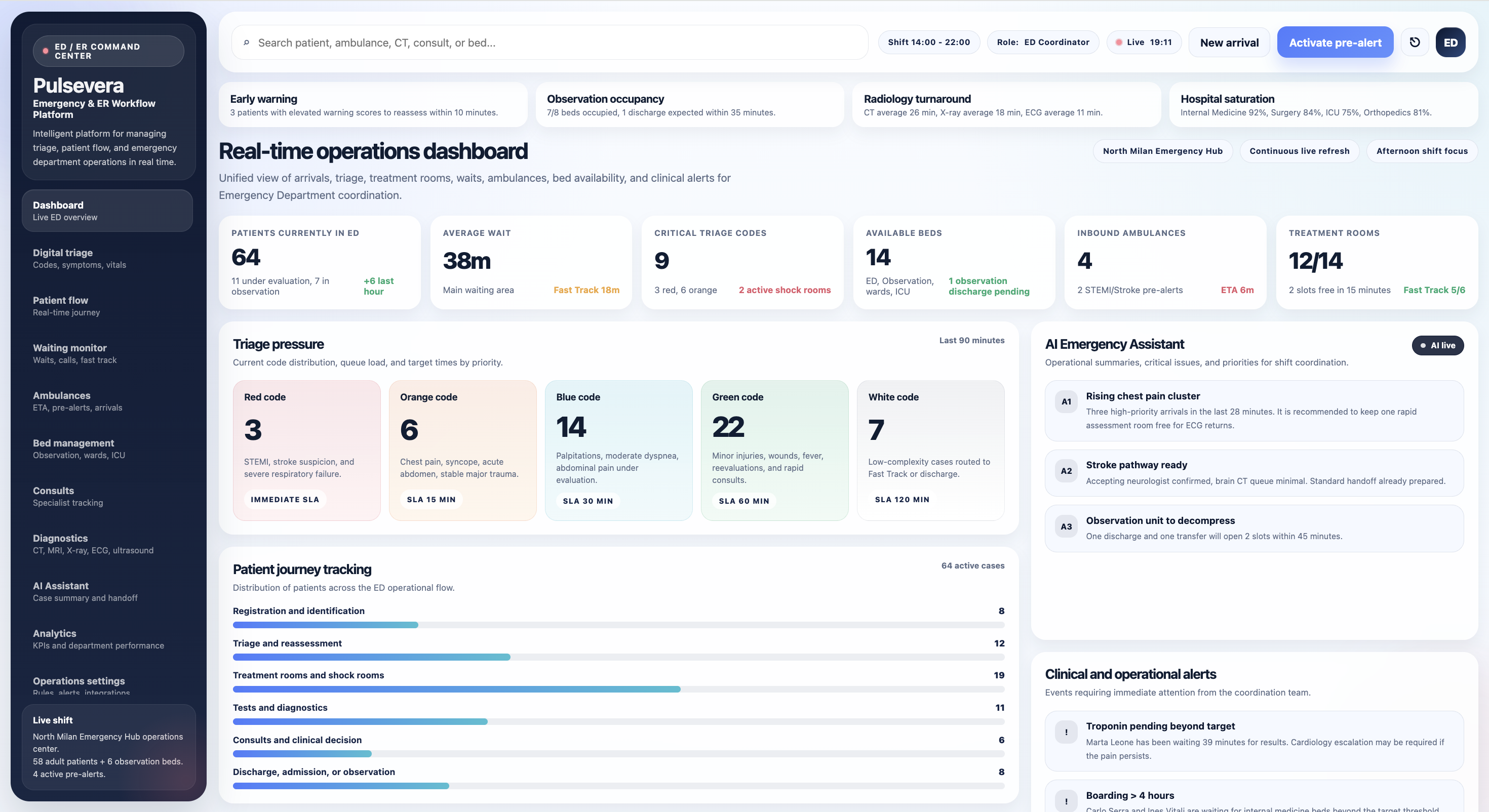
A real-time dashboard that lets you see arrivals, codes, seats, alerts, and shift status all at a glance.

Live Overview

The dashboard displays triage pressure, bed availability, average wait times, clinical alerts, incoming ambulances, and the status of operating areas all on a single screen.

  • It immediately highlights the priorities in the emergency room without having to switch between different forms.
  • It combines triage, wait times, occupancy, alerts, and the AI Emergency Assistant into a single, easy-to-read view.
Digital Triage

Digital Triage

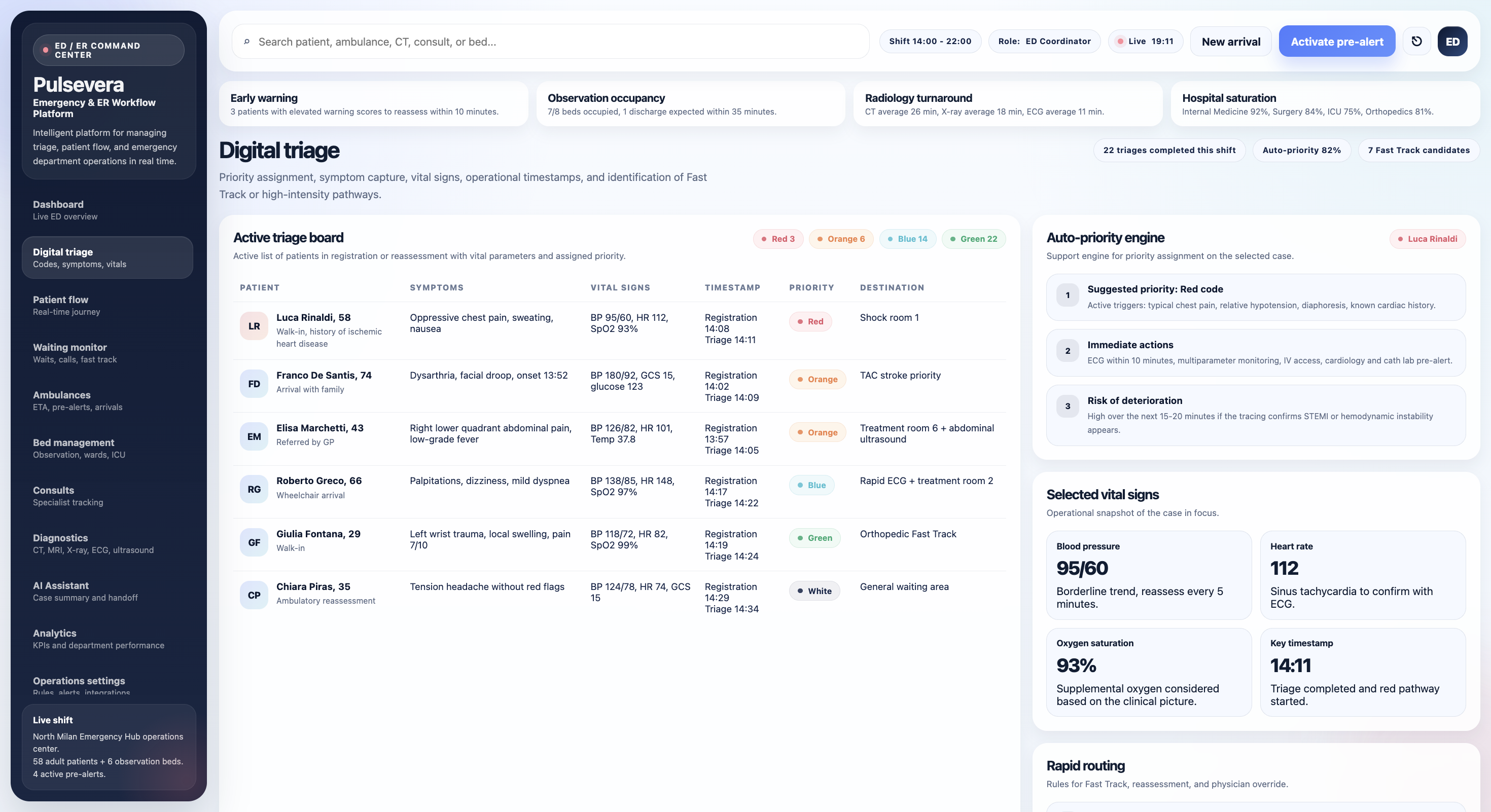
Priorities, symptoms, vital signs, and reassignments are all gathered at a modern, efficient triage station.

Priority Routing

Pulsevera streamlines triage with a live dashboard, filters by code, vital sign monitoring, urgency levels, and operational recommendations that help the team quickly classify and reassess patients.

  • Codes, symptoms, clinical ETA, and care assignment targets remain visible at all times.
  • Automatic reassessment helps ensure that you don't miss any worsening conditions or changes in priorities.
  • Fast Track and auto-priority make the triage process faster and more organized.
Patient Tracking

Patient Flow

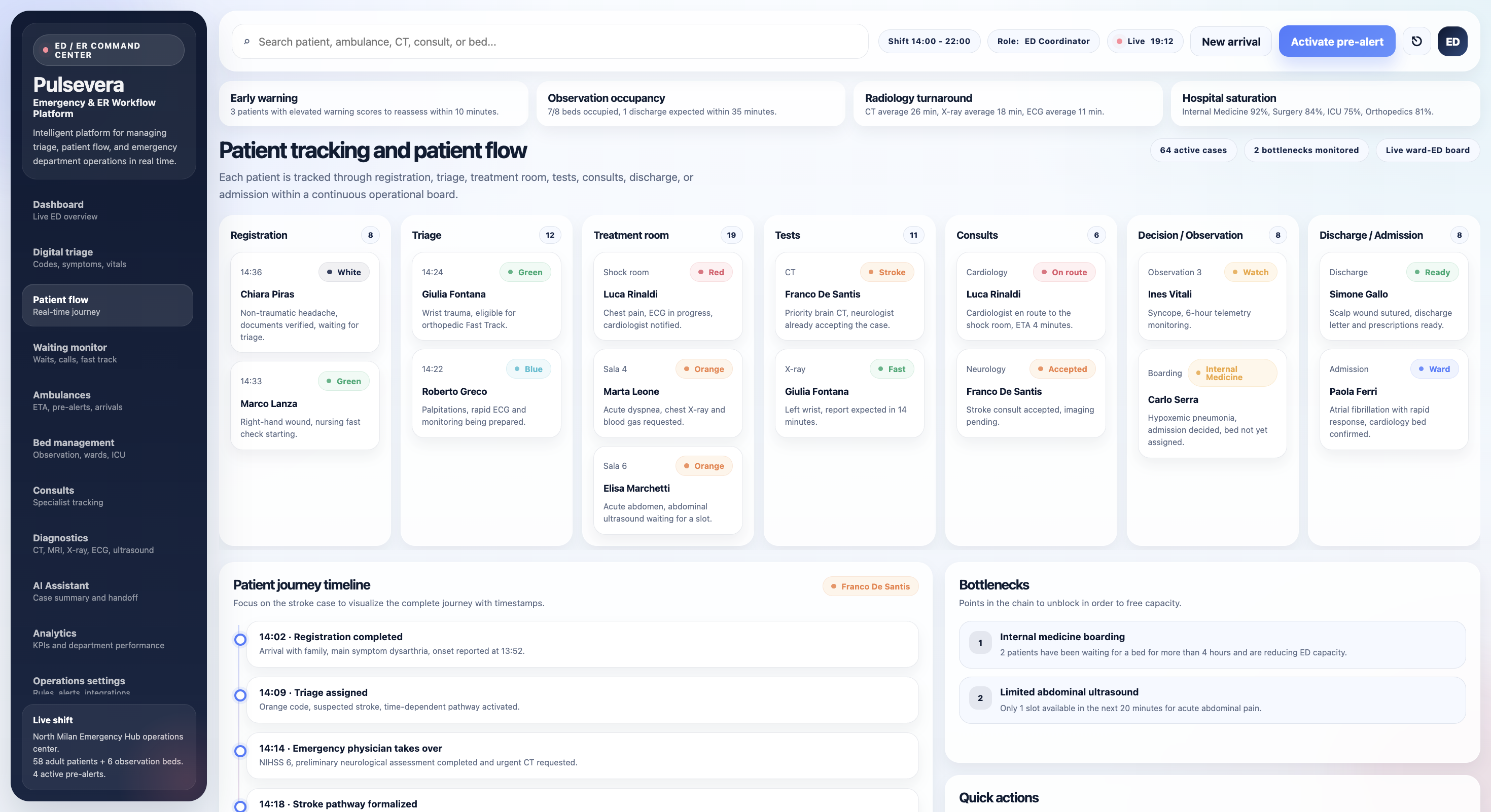
Each patient is monitored from admission to discharge as part of a continuous and transparent workflow.

Journey Board

The patient flow view shows where each case is in the process, which steps have already been completed, which bottlenecks are slowing down the department, and what the next operational step is.

  • It ensures continuity between registration, the visit, diagnostic tests, consultations, and the final decision.
  • The internal timeline helps reconstruct time-dependent events such as a stroke or STEMI.
  • Bottlenecks become apparent right away, so coordination becomes easier.
Waiting Room Management

Waiting Monitor

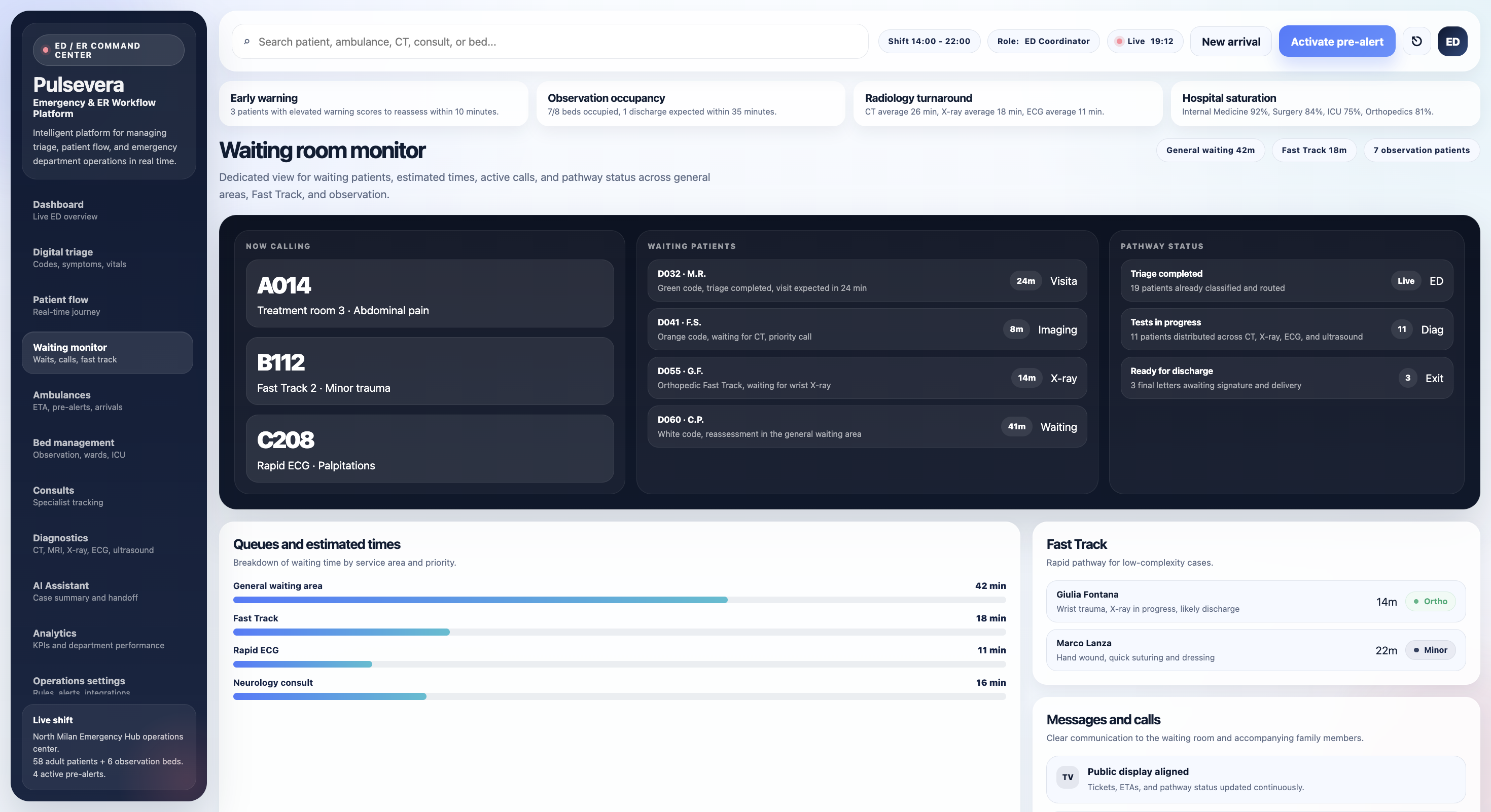
Waiting lists, call-ups, estimated wait times, and the status of the queues are always visible for the waiting room, Fast Track, and observation area.

Waiting flow

The wait time monitor helps you understand who is waiting, how long they have been waiting, which areas are under pressure, and where it is best to take action to reduce operational friction and downtime.

  • Average times and patient status can be viewed without opening other screens.
  • It helps manage waiting rooms, calls, and Fast Track with a more streamlined process.
Pre-hospital coordination

Ambulances

Pre-alerts, estimated times of arrival (ETAs), incoming vehicles, and handoffs are coordinated even before the patient enters the ward.

Pre-alert hub

Pulsevera provides a dedicated console for incoming ambulances that displays information on priority, route, patient being transported, estimated arrival time, handoff, and bay occupancy.

  • It reduces the chaos upon arrival because the team can prepare before making contact.
  • It helps manage STEMI, stroke, trauma, and other high-priority cases with a smoother handoff.
Capacity Orchestration

Bed Management

Observation, admission, beds, wards, and the ICU are all consolidated into a single operational view.

Capacity View

The bed management section centralizes information on bed availability, patients awaiting admission, transfers, pressure on hospital wards, and coordination between the emergency room, observation unit, and final destinations.

  • It helps you quickly identify where resignations or assignments are getting held up.
  • It reduces extended boarding by providing greater transparency regarding the facility's actual capacity.
Specialist Coordination

Consultations

Specialized requests don't get lost amid phone calls and notes: timelines, status, and workflows remain under control.

SLA Consultations

Pulsevera organizes consultations in neurology, cardiology, surgery, orthopedics, and other specialties, with real-time status updates, request tracking, clinical prioritization, and response times.

  • Coordination between teams becomes visible instead of getting lost in chats or calls.
  • Time-dependent pathways are safer when the specialist, imaging, and operating room are coordinated.
Diagnostics Control

Diagnostics

CT, MRI, X-ray, ECG, and ultrasound images are displayed on a clear, user-friendly, and easy-to-read console.

Flow Imaging

The diagnostics section provides an overview of active requests, average turnaround times, priority tests, radiology wait times, and handoffs between the emergency department and the diagnostic imaging department.

  • It allows you to immediately identify which requests are slowing down the department.
  • It makes it easier to prioritize strokes, trauma cases, urgent ECGs, and time-sensitive imaging.
AI Emergency Assistant

AI Assistant

The AI assistant prepares summaries, handoffs, and operational priorities without sounding like a generic chatbot.

Handoff AI

Pulsevera includes a discreet, medical-grade AI assistant that summarizes the case, flags immediate risks, suggests the next steps, and generates handoff reports ready for teams and shift changes.

  • It reduces the time it takes to transfer a critical case to another team.
  • It helps create a clear summary when the department is under pressure.
  • It maintains a professional and business-like tone, not that of a consumer chat.
Emergency Analytics

Analytics

KPI, wait times, occupancy rates, and emergency department performance are analyzed promptly and professionally.

ED KPI

The analytics dashboard transforms department data into clear metrics on triage times, length of stay, physician pickups, critical codes, admissions, discharges, and operational workload.

  • It shows the numbers that really matter to those who manage an emergency room.
  • It helps you identify trends, saturation, and bottlenecks with clean, clear charts.
Operations Governance

Operations Settings

Rules, alerts, operational maps, integrations, and governance are configured within a robust enterprise-grade environment.

Operational Governance

Pulsevera centralizes revaluation thresholds, watchlists, room and bay maps, consultation routing, public monitors, roles, audit trails, and integrations into a single governance area.

  • Triage rules, alerting, and clinical routing can be adapted to the facility's actual workflow.
  • Audit trails, roles, and security policies help the organization monitor access, changes, and operational responsibilities.
Luxygroup

Custom development comes first. Pulsevera was born out of this experience.

Our work begins with custom projects: we analyze real needs, develop tailored solutions, and adapt every detail to the client’s operational workflow.

  • We build custom platforms when you need something unique.
  • Pulsevera is one of our proprietary SaaS products, designed for high-intensity emergency environments.
  • The product is already available in English, French, Spanish, Italian, and German, with the option to add any other language upon request.
  • If a customer has specific needs, we start with the product and customize it to truly meet those needs.
Floors
Custom Plan

Upon request

We customize it however you like: triage, workflow, roles, integrations, branding, and languages. It is available in English, French, Spanish, Italian, and German, and can be adapted to any other language upon request.